You’ve chosen dinner. Everyone else has chosen a drink. You’re still looking for the alcohol-free section.
When you find it, the options sound familiar: a version of the gin you usually order, a beer without the alcohol, something that promises to taste almost like wine.
Sometimes that is exactly what you want. A familiar flavour, the same glass, an easy order that doesn’t turn into a conversation about why you aren’t drinking.
Other times, you weren’t looking for a convincing replacement. You just wanted something good.
That feels like a reasonable thing to ask of a drinks menu.
Familiarity has a purpose
There is a reason alcohol-free drinks often resemble alcoholic ones. The familiar bottle or glass can make taking part feel easier.
In a small UK study based on 15 in-depth interviews with consumers of no- and low-alcohol drinks, sociologist Emily Nicholls explored how these products fitted into social occasions. Participants described feeling included in drinking rituals and, in some cases, using the drinks to avoid drawing attention to the fact that they weren’t drinking alcohol.[1]
The interviews cannot tell us how everyone feels. But they capture something recognisable: sometimes you want to join the round without becoming the subject of it.
An alcohol-free beer can make that straightforward. It can also be something you enjoy for its own taste. There is no need to dismiss either reason.
The question is whether familiarity should be the only ambition.
“Almost the same” is a narrow brief
If a drink is introduced as an alternative to a favourite wine, the comparison has already been chosen. You start looking for the things you remember: the body, the dryness, the finish. Every difference becomes noticeable.
That can be a fair test for a product trying to recreate wine. It is a less useful test for every drink that happens to contain no alcohol.
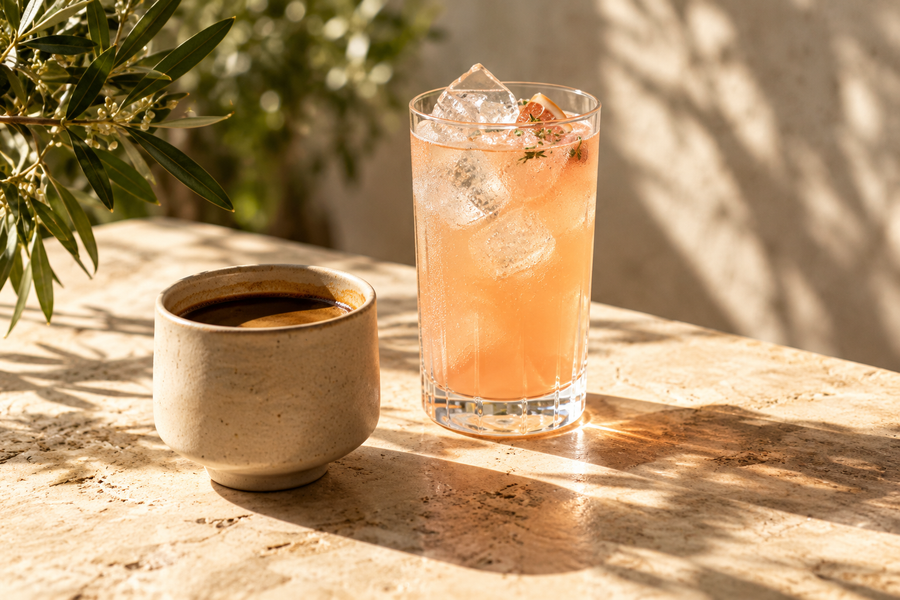
A peach drink with lime doesn’t need to resemble a cocktail you already know. A sharp, sparkling botanical drink can have its own flavour. Something served over ice can be worth ordering because you like it, without first proving how well it copies something else.
There is room for both. The familiar favourite, and the drink you haven’t had before.
What people miss may be more than the liquid
Think about the details around a drink you look forward to. The cold glass. The sound of ice. Someone asking what you would like, then taking a little care over making it.
You can miss that attention when the alternative arrives as a can and an empty tumbler while everyone else gets the full treatment.
For a host, this is an easy place to make a difference. Offer the alcohol-free choice when you offer everything else. Put it in a glass you would happily use yourself. If it needs ice or a garnish, give it the same care. Let someone choose it without asking for a reason.
At home, the same idea applies. You can make something because it tastes good alongside dinner, or because you enjoy making it. An ordinary evening is enough of an occasion.
A different drink doesn’t need to promise a different person
There is another expectation worth questioning: that an alcohol-free drink should somehow reproduce every part of drinking alcohol, including how it makes you feel.
That is a much bigger promise than matching a flavour. A drink can be enjoyable, useful or part of a social ritual without guaranteeing confidence, relaxation or an effortless conversation.
For ROMU, this leaves room for Elevate to have its own identity: a Tropical nootropic powder developed with work and social occasions in mind. It doesn’t need to impersonate a spirit to belong in someone’s plans. Whether it suits the occasion depends on what that person wants, including whether they want caffeine.
The same freedom should extend to everything else on the menu. Some people want a familiar beer. Some want a carefully made soft drink. Some want water. None of those choices needs an explanation.
Give the drink a chance to be itself
Next time you order something alcohol-free, try asking what you actually feel like drinking. Something sharp? Something fruity? Something that goes well with the food?
It is a more enjoyable starting point than working backwards from what you’ve decided not to have.
The best compliment might be very simple:
“I’d order that again.”